
Why Sloped Backyards Require More Than a Beautiful Pool Design
Infinity edge pools are among the most visually striking additions to an Austin property, particularly when the backyard has a natural slope that can be incorporated into the design. The disappearing waterline creates a sense of openness, making the pool appear to merge with the surrounding landscape and distant horizon. However, the visual simplicity of an infinity edge conceals a sophisticated structural and hydraulic system beneath the surface. A sloped backyard introduces changes in elevation, soil conditions, drainage patterns, retaining requirements, and structural loading that must all be addressed before construction begins. The pool cannot simply follow the natural grade without careful engineering because water places substantial and continuously changing pressure on the structure. For homeowners considering this type of project, understanding the engineering behind the finished appearance can help explain why site evaluation and detailed planning are so important.
Understanding the Challenge of an Austin Slope
A sloped backyard can create excellent opportunities for an infinity edge because the change in elevation can help establish the visual relationship between the pool and the surrounding terrain. At the same time, that slope means the pool structure may sit at significantly different elevations from one end to another. Excavation therefore needs to be carefully planned so that the finished pool does not create unstable soil conditions or interfere with existing drainage routes. Austin properties can also present varying soil characteristics, including expansive clay that can respond to changes in moisture content and place movement pressures on structures. This makes the relationship between the pool shell, surrounding soil, retaining structures, and drainage system especially important. Before excavation begins, we evaluate how the proposed pool will interact with the existing grade rather than treating the backyard as a simple flat construction site.
The Structural Role of the Pool Shell
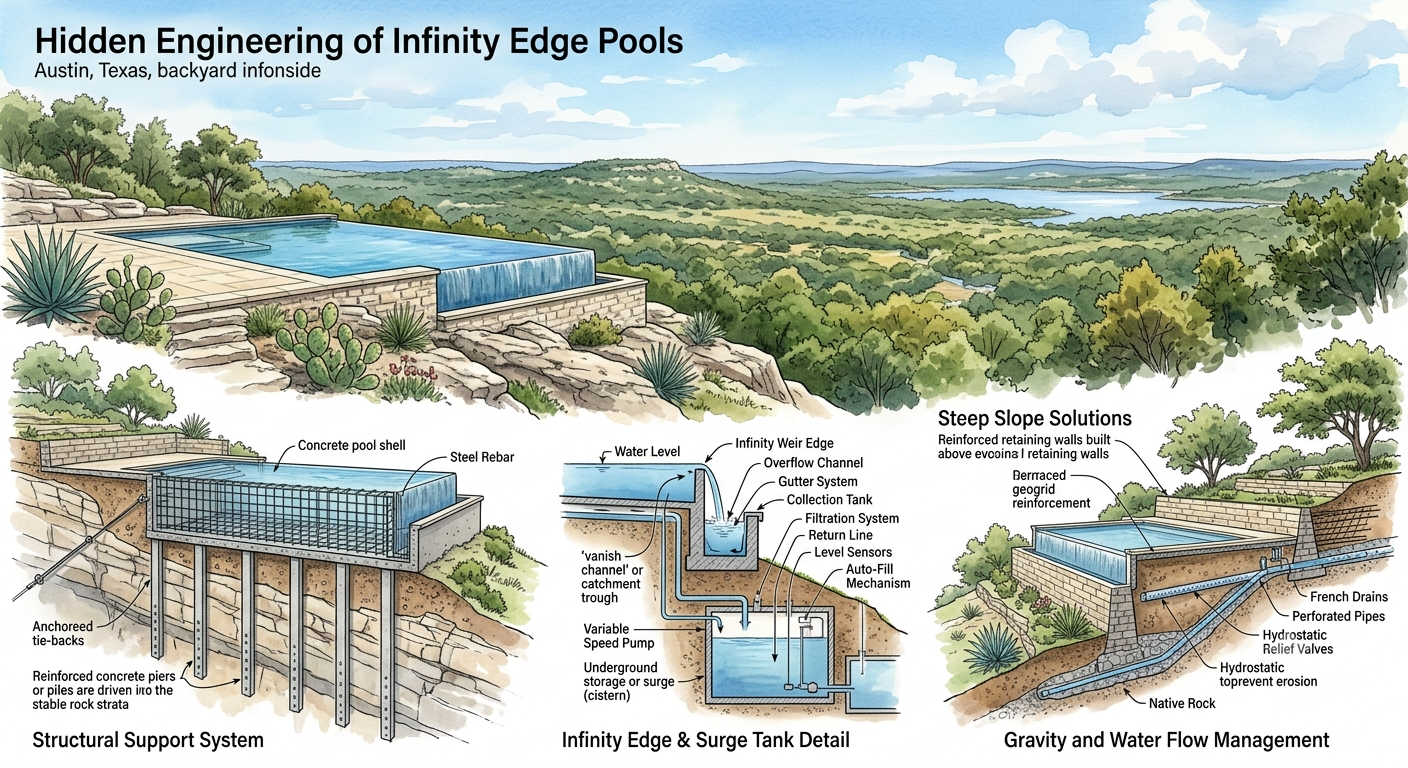
The reinforced concrete pool shell is one of the most important engineering components in an infinity edge installation. It must withstand the pressure created by the water inside the pool while also responding to the forces transmitted through the surrounding ground. On a sloped site, these forces can become more complicated because soil pressure and elevation are not uniform around the entire structure. The shell therefore needs to be designed with the site conditions, geometry, reinforcement requirements, and surrounding structures in mind. Proper structural detailing helps reduce the risk of cracking, movement, settlement, or other problems that could compromise the pool over time. A visually elegant pool depends on a structure that has been engineered to remain stable long after construction is complete.
Retaining Structures and Elevation Changes
Some sloped Austin backyards require retaining structures as part of the overall pool design. These structures may support portions of the surrounding landscape or help manage the transition between different elevations created by excavation and the finished pool. Their design must account for soil pressure, drainage, surcharge loads, groundwater conditions, and the relationship between the retaining structure and the pool itself. Poorly managed water behind a retaining wall can create hydrostatic pressure that places unnecessary stress on the structure. For this reason, drainage should be treated as a fundamental component of the engineering rather than as an afterthought. The final landscape may make these structures almost invisible, but their contribution to the stability of the backyard can be substantial.
How the Infinity Edge Actually Works
The disappearing edge is not simply a section of pool wall that has been lowered. It is part of a carefully coordinated hydraulic system that allows water to flow over the edge into a lower catch basin or trough. From there, the water is collected and returned to the main pool through a dedicated circulation system. The elevation of the infinity edge has to be established with considerable precision because the visual effect depends on maintaining a consistent water level across the overflow edge. Even relatively small inconsistencies can become noticeable once water begins flowing continuously across the edge. The catch basin, return plumbing, pumps, and control system must therefore work together to maintain the desired hydraulic balance.
The Importance of the Catch Basin
Behind the visual drama of an infinity edge is a catch basin that performs a critical operational function. As water flows over the edge, the basin captures it before it can move into the surrounding landscape or lower part of the property. The basin must have sufficient capacity for the expected flow and must be positioned at an appropriate elevation relative to the pool. Its structural design is also important because it becomes another water-containing structure that must remain stable within the site. Access for maintenance should be considered during the design process so that pumps, filters, valves, and other equipment can be serviced without unnecessary disruption. A properly engineered catch basin allows the infinity edge to remain visually clean while providing the hydraulic infrastructure required for reliable operation.
Precision in Hydraulic Design
Hydraulic engineering becomes particularly important when an infinity pool is designed on a slope because gravity naturally influences how water moves through the system. Pipe sizing, pump capacity, flow rates, suction conditions, return locations, and elevation differences all affect how efficiently the system operates. If the circulation system is undersized, the edge may not produce the consistent overflow homeowners expect. If components are improperly configured, the system can experience unnecessary energy consumption or operational instability. The hydraulic design must also accommodate normal water loss from evaporation and splash-out, particularly during periods of heavy use. Our approach considers the complete circulation system as part of the pool design rather than treating the infinity edge as an isolated visual feature.
Drainage Is Critical on Sloped Properties
Water management becomes even more important when a swimming pool is installed into an inclined backyard. Rainwater moving down the natural grade must be directed away from areas where it could undermine soil, affect retaining structures, or accumulate around the pool shell. Subsurface drainage can be necessary to control water that is not visible at the surface. Surface grading, collection drains, discharge routes, and waterproofing details may all contribute to the overall drainage strategy. Austin’s intense rainfall events make it particularly important to understand how stormwater behaves across the property before construction begins. Good drainage engineering protects not only the pool but also the surrounding hardscape, landscaping, retaining structures, and foundation areas.
Managing Expansive Soil Conditions
Soil behavior is another hidden factor that can influence the long-term performance of an infinity pool. Certain Austin soils contain significant clay content and can expand when moisture increases and contract when moisture decreases. Repeated changes in soil volume can create movement that affects structures if the site is not properly prepared and engineered. Soil investigation and appropriate excavation practices can help determine how the pool should be constructed for the specific property. The engineering solution may involve considerations for reinforcement, soil preparation, drainage, or other structural measures depending on the site. Treating every backyard as if it has identical soil conditions can create unnecessary risk, which is why site-specific evaluation matters.
Waterproofing and Movement Control
Waterproofing is another layer of engineering that is rarely visible once the pool is finished. The pool shell, construction joints, penetrations, plumbing connections, and surrounding structures all need to be considered as part of the water-retention system. Concrete is strong and durable, but it is not completely immune to movement or cracking. Proper detailing can help manage the locations and behavior of potential cracks while reducing opportunities for water intrusion. On a sloped property, the interaction between the pool structure and surrounding ground makes these considerations even more important. A carefully planned waterproofing strategy helps protect the pool’s structure and reduces the likelihood of long-term maintenance problems.
Integrating the Pool With the Landscape
An infinity pool should not appear to have been placed on top of a sloped backyard as an independent object. The best designs integrate the pool with the architecture, landscape, retaining elements, outdoor living spaces, and existing grade. Changes in elevation can be used to create terraces, seating areas, planting zones, or visual transitions that make the entire backyard feel intentional. The infinity edge can also be positioned to emphasize a particular view while maintaining appropriate structural and hydraulic conditions. This requires coordination between pool design and landscape planning from the beginning of the project. When these elements are considered together, engineering requirements can become part of the architectural character rather than something that has to be hidden after construction.
Equipment Placement Matters More Than Most Homeowners Expect
Pool equipment placement is another important consideration for a complex infinity edge installation. Pumps, filtration equipment, automation components, valves, and other mechanical systems require adequate space and appropriate access for inspection and maintenance. On a sloped property, the equipment location can also affect hydraulic performance because changes in elevation influence pumping requirements and plumbing configuration. Locating equipment too far away or at an unsuitable elevation can increase system complexity and reduce efficiency. Equipment areas should therefore be incorporated into the site plan before construction rather than being squeezed into whatever space remains afterward. Thoughtful placement can make routine maintenance easier while helping the overall system operate efficiently.
Building for Long-Term Performance
The engineering behind an infinity pool should always be considered in terms of long-term performance rather than simply the day construction is completed. The pool will experience seasonal temperature changes, water pressure, soil movement, rainfall, evaporation, equipment cycling, and regular use for many years. Every one of these factors can influence the performance of the structure and mechanical systems. A design that looks impressive on opening day but ignores future maintenance and environmental conditions can become expensive to operate or repair. Proper engineering considers how individual components will work together throughout the life of the pool. At Renaissance Pools, we focus on creating pool environments where the visual design is supported by the structural, hydraulic, drainage, and site-planning considerations required for lasting performance.
Why Site-Specific Engineering Makes a Difference
No two sloped backyards are exactly alike, even when two properties appear similar from the street. Differences in grade, soil, drainage, existing structures, property boundaries, access, and desired pool elevation can substantially change the engineering requirements. A standardized approach may overlook conditions that become important once excavation begins. Detailed measurements and careful site planning provide a clearer understanding of how the pool should interact with the existing property. This information can also help establish realistic expectations regarding excavation, retaining structures, equipment locations, and construction complexity. A successful infinity pool begins with understanding the site rather than trying to force the site into a predetermined design.
Turning Complex Engineering Into a Seamless Backyard
The most impressive infinity pools often appear effortless because the complicated engineering has been successfully concealed within the finished design. The clean waterline, uninterrupted overflow, carefully framed view, and integrated landscaping can make the entire installation look remarkably simple. Behind that simplicity are structural calculations, hydraulic planning, drainage systems, soil considerations, equipment coordination, waterproofing details, and careful construction sequencing. Each component has a specific role in ensuring that the finished pool performs as intended. When these elements are coordinated from the beginning, a challenging sloped backyard can become an opportunity rather than a limitation. The result is a pool that does more than follow the terrain because it uses the terrain as part of the overall design concept.